Latest Post
17th edition consumer unit 17th edition glasgow 2014 Glasgow commonwealth Games 2014 metal consumer unit 24 hour emergency electrician Aceh Aleppo all trades company glasgow Archive Article Beauty BG Fuse Board Bikes Biograph boiler installer glasgow Browser Business business and technology news business technology news call out heating engineer cctv glasgow cctv news CERTIFICATES GLASGOW cheap kitchesn glasgow cheques christmas led lights clarkston electrician company health insurance compare private health insurance Consumer unit consumer units glasgow council electricians renfrewshire crookston electricians Culture currency Downloads eicr glasgow electric cars westend glasgow electric showers electricains clarkston glasgow ELECTRICAL CONTRACTOR electrical contractor crookston. Electrical contractor Glasgow electrical installation paisley electrical safety electrical testing london electrician electrician bearsden ELECTRICIAN EICR GLASGOW electrician glasgow electrician kitchens electricians electricians 24 hours glasgow electricians 24 hours london electricians bellahouston electricians birmingham electricians clarkston electricians east kilbride electricians giffnock electricians glasgow electricians glasgow city centre electricians hyndland westend glasgow electricians in giffnock electricians in glasgow electricians in greenock and port glasgow electricians in south side clarkston consumer unit clarkston electricians london electricians mosspark electricians niceic electricians paisley electricians west end glasgow electricians westend glasgow electricians westend glasogw eletricians newton mearns emergency call out electricians Event Fashion Favourite Feature Featured Posts Fellowship Flags Food Genel fusebox clarkston fusebox south side glasgow Gadgets Gallery Games gas central heating glasgow gas engineer gas fitter gas safe Gear giffnock electrical contractor giffnock electricians giffnock electricins giffnock spark giffock local electrician Glasgow glasgow electrical contractor Health health information technology health insurance quote History Holy info internet technology news Journalism landlord electrical safety check landlords electricians latest innovations in technology Life & style Magazine metal consumer unit Mine Movies Reviews Music Musik new business technology new consumer units new internet technology new technology for business new technology in business News NICEIC PAT TESTING pat testing glasgow Politics private health cover private health insurance private medical insurance Random Regional Reviews sejarah select electricians glasgow Shooting Slider solar power south side glasgow electrician Sports Surabaya Technology Templates testing glasgow TopDownload Travel travel health insurance travel money travellers Turkey Tutorial Tutorials UK ver Video wes electrical west end glasgow electricians westend electrical saftey WESTEND GALSGOW ELECTRICAL CONTRACTOR westend glasgow 24 hour emergency electrician westend glasgow 24 hours electricians westend glasgow electricians westend glasgow rewire Wisata

Free CSS HTML Simple Magazine News Template, High Quality Design Web Template By Arcsin, Come with Web2.0 Interface, Blue and White Colors, 3 Columns, Right Sidebars, Top Header Menu and Fixed Width, Suitable Template for a News Magazine Website or Personal News Page.
Source availaible : .HTML and .CSS Files, To change the CSS open styles.css in a HTML/CSS Editor and Change The Appropriate Values to Suit Your Needs, Tested and work Fine On Mozilla Firefox, Opera, Safari, Internet Explorer and Google Chrome web Broswers, This work is under Creative Commons Attribution-Share Alike 3.0 License, This means you may use it and make any changes you like, However, credit links must remain on footer for legal use, This Template Come With 1 Column Style, 2 Columns Style and 3 Columns Style Design.

Free CSS HTML Simple Magazine News TemplateFree CSS Template
Free CSS HTML Simple Magazine News Template Two Columns
Free CSS HTML Simple Magazine News Template Table-Based Layout
Free CSS HTML Simple Magazine News Template Fixed Width 


Over the last ten years I have seen many intranets develop from simple document lists to powerful portals that act as the central hub of a business. During this time I have attained an excellent understanding of the factors which influence intranets, which has allowed us to create a model for success. This has traditionally been based on the three pillars of Communications, Business Processes and Knowledge Management.

By Nigel Danson  
There has been a lot of buzz recently about using the intranet as a collaborative tool to facilitate knowledge sharing amongst users, raising the questions as to whether collaboration is a key success factor. I think that there is definitely a good reason to add collaboration to our list, as it promotes mass participation and improves best practice.
This makes our four key success factors:

  • Communications -- e.g. News and events


  • Business Processes -- e.g. Absence Booking workflow


  • Knowledge Management -- e.g. Best Practice documentation


  • Collaboration -- e.g. Cross-department working group discussion board

  • Early intranets were mainly communications driven and over time evolved into broader productivity tools that included more process-specific business applications and management tools. Intranets today do much more than simply host the staff directory and HR manuals - although these remain important. They are growing in strategic importance and increasingly incorporate collaboration support and Enterprise Social Networking features. 

    For an intranet to be truly successful it must provide a balance of all of these elements. Some elements may form a greater percentage of the whole depending on an organization's particular needs. Also, the proportional split of these elements may well alter over time to meet changing business and employee requirements.

    The ratio of these components will depend to some extent on the type of organization e.g. in a professional services organization the 'knowledge management' constituent is likely to form the largest element as these organizations usually have masses of documentation, research and policies that staff need access to, whereas in a more project based organization 'collaboration' may form the largest proportion with people working together in collaborative workspaces on the intranet.


    However, none of these elements should exist in isolation but have a connection with the other elements; there is a relationship between them in many instances. For example, a document about swine flu is published on the intranet and pushed out to staff via a 'communication' but it then forms part of the 'knowledge' of the organization. A collaborative intranet will enable people to comment on the document or ask questions about its content.


    A successful intranet will retain all this information and link it to other relevant information e.g. sickness policy, recent discussions on the subject, latest posts, HR presentation on swine flu and other users' comments on swine flu. This additional information may be spread out across the intranet in an unconnected way, but intelligent intranets should bring this information together and connect users to content in meaningful and contextual ways.


    This works rather like leading websites such as Amazon which use anonymous data collection technology to look at what users are browsing and buying; their purchase decisions, product searches and movement around the website adds to the site's store of anonymously gathered intelligence. This in turn develops insight into a user's preferences. It outputs this intelligence in peer-rated product suggestions. It is this same technology, applied to an internal audience, which will enable modern intranets to effectively 'push' the most current, useful and important content.


    In order to understand what each of these elements constitutes we need to look at what they should consist of in a successful intranet.

    Communications

    Tends to be information classified as time sensitive i.e. information with limited 'shelf life' e.g. corporate news announcements, internal job vacancies, corporate events, latest KPIs. This type of information is pushed to employees on a regular basis. Traditionally this element has formed the greatest part of most intranets. It is important that a good mechanism exists for making sure the right people see the right communications and it shouldn't get lost in an intranet 'black hole'. 


    Collaboration
    Collaboration can be defined as two or more people working together to achieve common goals by sharing knowledge, learning and building consensus. Research shows that a staggering 36% of a company's overall performance is driven by its ability to collaborate. (Source: Meetings Around the World: The Impact of Collaboration on Business Performance by Frost & Sullivan.)


    A real strength of successful intranets is the collaborative platform they can provide to organizations to help harness the collective intelligence of everyone. Increasingly Enterprise 2.0 technologies such as wikis and blogs are being used on intranets as they facilitate collaboration. Discussion boards, comments and feedback facilities on content, and polls also promote collaboration amongst employees.


    A recent report by ECM industry researcher, AIIM, shows that business take-up of Enterprise 2.0 has doubled in the last year.2 According to this report, there has been a dramatic increase in the understanding of how Enterprise 2.0 technologies such as wikis, blogs, forums, and social networks can be used to improve business collaboration and knowledge sharing, with over half of organizations now considering Enterprise 2.0 to be "important" or "very important" to their business goals and success. (Source: The AIIM research report is entitled "Collaboration and Enterprise 2.0: work meets play or the future of business?" Jun 09.)


    In the Nielsen Norman Group Intranet Design Annual 2009, a common theme amongst the Year's ten best intranets was the incorporation of Web 2.0 community and social features. They pointed out that "as social networking's popularity increases, more employees will expect such features on their intranets, too. Further, the intranet is a perfect place to use social networking because it can help employees share information and knowledge and find the right people for a job."

    Collaborative tools open up channels of communication across an organization. For example, project teams can have a collaborative workspace on intranet where they can contribute and share information. This can cut down on face to face meetings reducing the traveling time and therefore cutting costs, particularly if staff is spread across different locations. Collaborative tools empower staff by providing them with the ability to contribute opinion and share knowledge thus improving overall staff morale.
    In the real world intranet managers still see these collaborative tools as a draw into the intranet but have not fully appreciated the efficiency gains they can provide; In my opinion they promote knowledge sharing and best practice which leads to efficiency gains by improving productivity.

    However, the key to a successful intranet is that they should not merely provide the collaborative environment but they should actively connect all relevant information that has been amassed as a result of collaborative working and present this content to the users where relevant.


    For example, taking the swine flu scenario again, a user searches for information about swine flu and posts a comment asking a question, say, as to whether the company is offering vaccination against the virus. HR respond accordingly. All this information should then be stored in the intranet so when another person searches on swine flu they are presented with this information automatically. As more and more information on swine flu is added to the intranet it is automatically pushed to the relevant people without them having to laboriously track it down across several people and documents.


    Nigel Danson is managing director of Odyssey Interactive. Formed in 1996, Odyssey is one of the UK's longest established internet companies with specialist knowledge in intranet technology. The company specializes in providing the UK's leading out-of-the box intranet solution, Interact.

    Read More about Communications 

    Richard Milhous Nixon was born in Yorba Linda, Calif., on Jan. 9, 1913, to Midwestern-bred parents, Francis A. and Hannah Milhous Nixon, who raised their five sons as Quakers. Nixon was a high school debater and was undergraduate president at Whittier College in California, where he was graduated in 1934. As a scholarship student at Duke University Law School in North Carolina, he graduated third in his class in 1937.


    After five years as a lawyer, Nixon joined the navy in August 1942. He was an air transport officer in the South Pacific and a legal officer stateside before his discharge in 1946 as a lieutenant commander.

    Running for Congress in California as a Republican in 1946, Nixon defeated Rep. Jerry Voorhis. As a member of the House Un-American Activities Committee, he made a name as an investigator of Alger Hiss, a former high State Department official, who was later jailed for perjury. In 1950, Nixon defeated Rep. Helen Gahagan Douglas, a Democrat, for the Senate. He was criticized for portraying her as a Communist dupe.

    Nixon's anti-Communism ideals, his Western roots, and his youth figured into his selection in 1952 to run for vice president on the ticket headed by Dwight D. Eisenhower. Demands for Nixon's withdrawal followed disclosure that California businessmen had paid some of his Senate office expenses. His televised rebuttal, known as �the Checkers speech� (named for a cocker spaniel given to the Nixons), brought him support from the public and from Eisenhower. The ticket won easily in 1952 and again in 1956.

    Eisenhower gave Nixon substantive assignments, including missions to 56 countries. In Moscow in 1959, Nixon won acclaim for his defense of U.S. interests in an impromptu �kitchen debate� with Soviet premier Nikita S. Khrushchev.

    Nixon lost the 1960 race for the presidency to John F. Kennedy.

    In 1962, Nixon failed in a bid for California's governorship and seemed to be finished as a national candidate. He became a Wall Street lawyer, but kept his old party ties and developed new ones through constant travels to speak for Republicans.

    Nixon won the 1968 Republican presidential nomination after a shrewd primary campaign, then made Gov. Spiro T. Agnew of Maryland his surprise choice for vice president. In the election, they edged out the Democratic ticket headed by Vice President Hubert H. Humphrey by 510,314 votes out of 73,212,065 cast.

    Committed to winding down the U.S. role in the Vietnamese War, Nixon pursued �Vietnamization��training and equipping South Vietnamese to do their own fighting. American ground combat forces in Vietnam fell steadily from 540,000 when Nixon took office to none in 1973 when the military draft was ended. But there was heavy continuing use of U.S. air power.

    Nixon improved relations with Moscow and reopened the long-closed door to mainland China with a good-will trip there in Feb. 1972. In May of that same year, he visited Moscow and signed agreements on arms limitation and trade expansion and approved plans for a joint U.S.�Soviet space mission in 1975.

    Inflation was a campaign issue for Nixon, but he failed to master it as president. On Aug. 15, 1971, with unemployment edging up, Nixon abruptly announced a new economic policy: a 90-day wage-price freeze, stimulative tax cuts, a temporary 10% tariff, and spending cuts. A second phase, imposing guidelines on wage, price, and rent boosts, was announced Oct. 7.

    The economy responded in time for the 1972 campaign, in which Nixon played up his foreign-policy achievements. Played down was the burglary on June 17, 1972, of Democratic national headquarters in the Watergate apartment complex in Washington. The Nixon�Agnew reelection campaign cost a record $60 million and swamped the Democratic ticket headed by Sen. George McGovern of South Dakota with a plurality of 17,999,528 out of 77,718,554 votes. Only Massachusetts, with 14 electoral votes, and the District of Columbia, with 3, went for McGovern.

    In Jan. 1973, hints of a cover-up emerged at the trial of six men found guilty of the Watergate burglary. With a Senate investigation under way, Nixon announced on April 30 the resignations of his top aides, H. R. Haldeman and John D. Ehrlichman, and the dismissal of White House counsel John Dean III. Dean was the star witness at televised Senate hearings that exposed both a White House cover-up of Watergate and massive illegalities in Republican fund-raising in 1972.

    The hearings also disclosed that Nixon had routinely tape-recorded his office meetings and telephone conversations.

    On Oct. 10, 1973, Agnew resigned as vice president, then pleaded no-contest to a negotiated federal charge of evading income taxes on alleged bribes. Two days later, Nixon nominated the House minority leader, Rep. Gerald R. Ford of Michigan, as the new vice president. Congress confirmed Ford on Dec. 6, 1973.

    In June 1974, Nixon visited Israel and four Arab nations. Then he met in Moscow with Soviet leader Leonid I. Brezhnev and reached preliminary nuclear arms limitation agreements.

    But, in the month after his return, Watergate ended the Nixon regime. On July 24 the Supreme Court ordered Nixon to surrender subpoenaed tapes. On July 30, the Judiciary Committee referred three impeachment articles to the full membership. On Aug. 5, Nixon bowed to the Supreme Court and released tapes showing he halted an FBI probe of the Watergate burglary six days after it occurred. It was in effect an admission of obstruction of justice, and impeachment appeared inevitable.

    Nixon resigned on Aug. 9, 1974, the first president ever to do so. A month later, President Ford issued an unconditional pardon for any offenses Nixon might have committed as president, thus forestalling possible prosecution.

    In 1940, Nixon married Thelma Catherine (Pat) Ryan. They had two daughters, Patricia (Tricia) and Julie, who married Dwight David Eisenhower II, grandson of the former president.

    He died on April 22, 1994, in New York City of a massive stroke.


    Source: Richard Milhous Nixon

    The Great Seal of the U.S.

    On July 4, 1776, the Continental Congress appointed a committee consisting of Benjamin Franklin, John Adams, and Thomas Jefferson "to bring in a device for a seal of the United States of America." After many delays, a verbal description of a design by William Barton was finally approved by Congress on June 20, 1782. The seal shows an American bald eagle with a ribbon in its mouth bearing the device E pluribus unum (One out of many).
    In its talons are the arrows of war and an olive branch of peace. On the reverse side it shows an unfinished pyramid with an eye (the eye of Providence) above it. Although this description was adopted in 1782, the first drawing was not made until four years later, and no die has ever been cut.

    The U.S. Flag

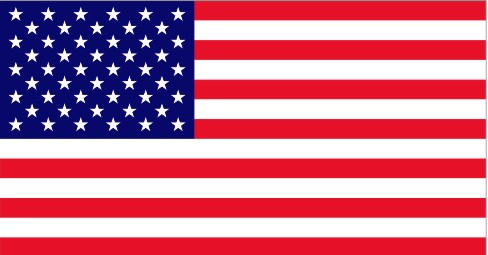
    In 1777 the Continental Congress decided that the flag would have 13 alternating red and white stripes, for the 13 colonies, and 13 white stars on a blue background. A new star has been added for every new state. Today the flag has 50 stars.

    Bald Eagle

    The bald eagle has been our national bird since 1782. The Founding Fathers had been unable to agree on which native bird should have the honor-Benjamin Franklin strongly preferred the turkey! Besides appearing on the Great Seal, the bald eagle is also pictured on coins, the $1 bill, all official U.S. seals, and the President's flag.


    Uncle Sam

    The image of Uncle Sam, with his white hair and top hat, first became famous on World War I recruiting posters. The artist, James Montgomery Flagg, used himself as a model. But the term dates back to the War of 1812, when a meat-packer nicknamed Uncle Sam supplied beef to the troops. The initials for his nickname were quite appropriate!


    Source: Symbols of the United States

    According to popular legend, the first American flag was made by Betsy Ross, a Philadelphia seamstress who was acquainted with George Washington, leader of the Continental Army, and other influential Philadelphians. In May 1776, so the story goes, General Washington and two representatives from the Continental Congress visited Ross at her upholstery shop and showed her a rough design of the flag. Although Washington initially favored using a star with six points, Ross advocated for a five-pointed star, which could be cut with just one quick snip of the scissors, and the gentlemen were won over.


    Unfortunately, historians have never been able to verify this charming version of events, although it is known that Ross made flags for the navy of Pennsylvania. The story of Washington's visit to the flagmaker became popular about the time of the country's first centennial, after William Canby, a grandson of Ross, told about her role in shaping U.S. history in a speech given at the Philadelphia Historical Society in March 1870.


    What is known is that the first unofficial national flag, called the Grand Union Flag or the Continental Colours, was raised at the behest of General Washington near his headquarters outside Boston, Mass., on Jan. 1, 1776. The flag had 13 alternating red and white horizontal stripes and the British Union Flag (a predecessor of the Union Jack) in the canton. Another early flag had a rattlesnake and the motto �Don't Tread on Me.�


    The first official national flag, also known as the Stars and Stripes, was approved by the Continental Congress on June 14, 1777. The blue canton contained 13 stars, representing the original 13 colonies, but the layout varied. Although nobody knows for sure who designed the flag, it may have been Continental Congress member Francis Hopkinson.


    After Vermont and Kentucky were admitted to the Union in 1791 and 1792, respectively, two more stars and two more stripes were added in 1795. This 15-star, 15-stripe flag was the �star-spangled banner� that inspired lawyer Francis Scott Key to write the poem that later became the U.S. national anthem.


    In 1818, after five more states had gained admittance, Congress passed legislation fixing the number of stripes at 13 and requiring that the number of stars equal the number of states. The last new star, bringing the total to 50, was added on July 4, 1960, after Hawaii became a state.


    Read more: History of the American Flag

    Chomsky, Noam (nom chom'ske) [key], 1928�, educator and linguist, b. Philadelphia. Chomsky, who has taught at the Massachusetts Institute of Technology since 1955, developed a theory of transformational (sometimes called generative or transformational-generative) grammar that revolutionized the scientific study of language.

    He first set out his abstract analysis of language in his doctoral dissertation (1955) and Syntactic Structures (1957). Instead of starting with minimal sounds, as the structural linguists had done, Chomsky began with the rudimentary or primitive sentence; from this base he developed his argument that innumerable syntactic combinations can be generated by means of a complex series of rules.

    According to transformational grammar, every intelligible sentence conforms not only to grammatical rules peculiar to its particular language, but also to �deep structures,� a universal grammar underlying all languages and corresponding to an innate capacity of the human brain. Chomsky and other linguists who built on his work formulated transformational rules, which transform a sentence with a given grammatical structure (e.g., �John saw Mary�) into a sentence with a different grammatical structure but the same essential meaning (�Mary was seen by John�). Transformational linguistics has been influential in psycholinguistics, particularly in the study of language acquisition by children.

    In the 1990s Chomsky formulated a �Minimalist Program� in an attempt to simplify the symbolic representations of the language facility. Chomsky is a prolific author whose principal linguistic works after Syntactic Structures include Current Issues in Linguistic Theory (1964), The Sound Pattern of English (with Morris Halle, 1968), Language and Mind (1972), Studies on Semantics in Generative Grammar (1972), Knowledge of Language (1986), Language and Thought (1993), and Architecture of Language (2000).
    Chomsky also has wide-ranging political interests. An early and outspoken critic of U.S. involvement in the Vietnam War and a vociferous opponent of the Iraq war, he has written extensively on many political issues from a generally left-wing point of view. Among his political writings are American Power and the New Mandarins (1969), Peace in the Middle East? (1974), Manufacturing Consent (with E. S. Herman, 1988), Profit over People (1998), Rogue States (2000), Hegemony or Survival (2003), and Failed States (2006). Chomsky's controversial bestseller 9-11 (2002) is an analysis of the World Trade Center attack that, while denouncing the atrocity of the event, traces its origins to the actions and power of the United States.

    See biography by R. F. Barsky (1997); interviews with D. Barsamian (1992, 1994, 1996, and 2001); studies by F. D'Agostino (1985), C. P. Otero (1988 and 1998), R. Salkie (1990), M. Achbar, ed. (1994), M. Rai (1995), V. J. Cook (1996), P. Wilkin (1997), J. McGilvray (1999), N. V. Smith (1999), A. Edgley (2000), and H. Lasnik (2000); Manufacturing Consent: Noam Chomsky and the Media (film by P. Wintonick and M. Achbar, 1992) and Power and Terror: Noam Chomsky in Our Times (documentary film dir. by J. Junkerman, 2002).


    Read more: Noam Chomsky

    MKRdezign

    Contact Form

    Name

    Email *

    Message *

    Powered by Blogger.
    Javascript DisablePlease Enable Javascript To See All Widget